
On Mechanistic Interpretability. A very simple explanation + Resources for in-depth study

Mechanistic interpretability is about understanding how artificial intelligence (AI) models, particularly large ones like neural networks, make their decisions. It aims to open the "black box" of AI and figure out what’s happening inside the model—step by step—when it processes information.
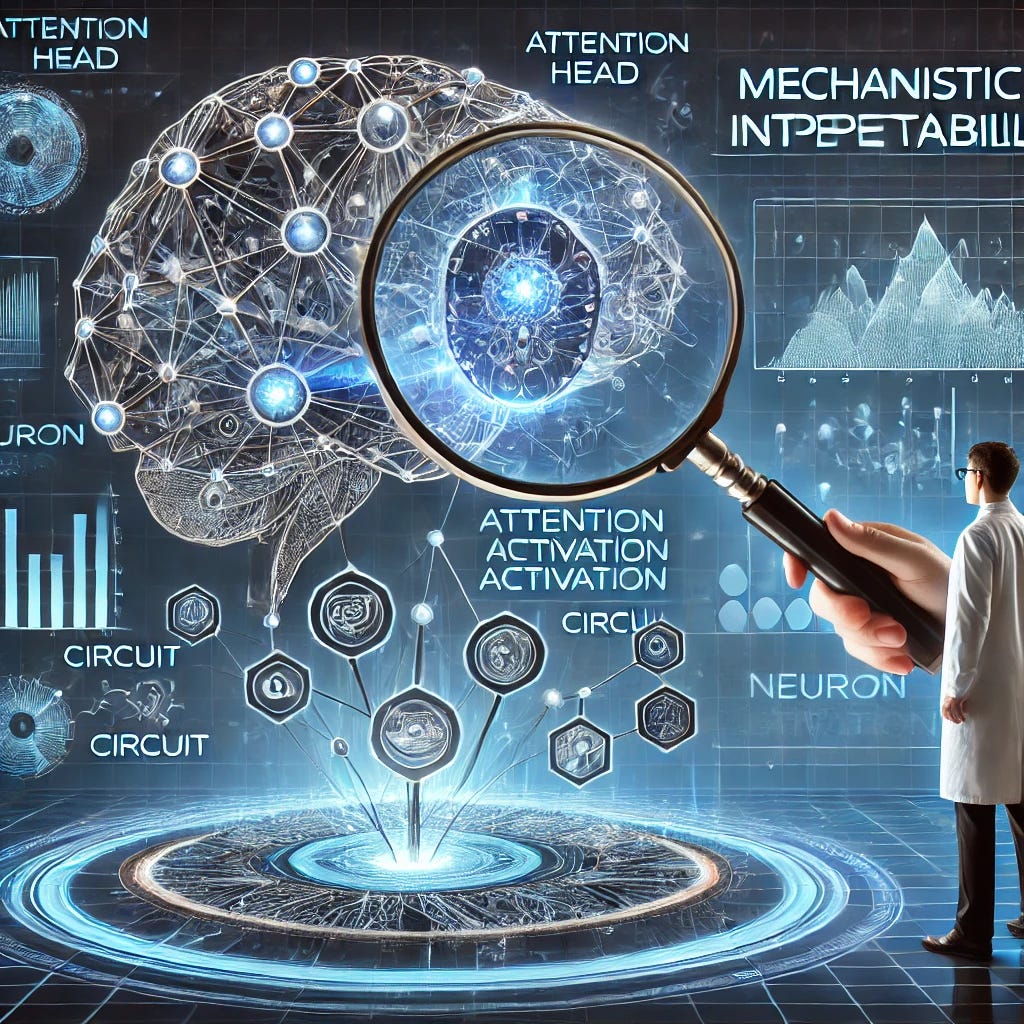
Here’s a simple analogy: imagine a calculator. We know how it adds or multiplies because we understand its internal mechanisms (e.g., circuits or code). Mechanistic interpretability tries to do the same thing for AI models, which are much more complex. It’s like reverse-engineering a machine to see how it works internally.
For example:
Breaking it into parts: Researchers might look at individual pieces of the model (called neurons or attention heads) to see what they are focusing on.
Understanding patterns: They analyze how these parts interact to detect patterns or make decisions, like recognizing an object in a picture or predicting the next word in a sentence.
Explaining behaviors: The goal is to link the internal workings of the model to its behavior, so we can say, "This part of the model is responsible for doing X."
But the people who developed these LLMs, don't they know how they work?
The people who develop large language models (LLMs) like GPT or similar systems do understand how they are built and the general principles behind their operation, but they don’t fully understand the detailed inner workings of the trained models. Here’s why:
The Design vs. Emergent Behavior:
Developers design the architecture of the model (e.g., the number of layers, how neurons connect, etc.) and specify how the model learns (using algorithms like gradient descent). However, when the model is trained on massive datasets, it learns patterns and strategies that weren’t explicitly programmed. This "emergent behavior" can surprise even the developers.For example, an LLM might "learn" to translate languages without being explicitly taught, just by analyzing large amounts of multilingual text.
The Complexity is Enormous:
LLMs like GPT have billions of parameters (numbers that control how the model operates). While developers know how these parameters are updated during training, understanding how the interactions of billions of parameters lead to specific decisions is extremely complex—like trying to understand every synapse in a brain.They’re Built as Black Boxes:
Models are optimized to give good results, not to be interpretable. During training, they figure out useful shortcuts or strategies to make accurate predictions, but these strategies aren’t always human-readable. Developers know the "input-output" relationship but not always the step-by-step reasoning.Unpredictable Learning:
Training a large model is like letting it explore a huge maze. Developers give it tools (like optimization techniques) to navigate the maze, but they don’t know in advance exactly how it will find its way or what it will "remember" from the journey.
Why Mechanistic Interpretability Matters
Mechanistic interpretability is the effort to reverse-engineer and understand these unexpected or hidden processes. It’s like trying to read the "thought process" of the AI after it has learned things developers didn’t directly teach it.
In short: Developers know how to build and train LLMs, but the specific behaviors and strategies these models develop during training often remain mysterious. That’s what mechanistic interpretability tries to uncover.
FURTHER EXPLORATION:
Mechanistic Interpretability, Variables, and the Importance of Interpretable Bases
Introduction to Mechanistic Interpretability – BlueDot Impact
Neel Nanda: He is one of the more well-known figures in the field of mechanistic interpretability. Infact I first came to know about about this topic through his conversation on the MLST Podcast.
A Comprehensive Mechanistic Interpretability Explainer & Glossary — Neel Nanda
Thanks for reading Decoding Compute Models! Subscribe for free to receive new posts and support my work.