
Quant Finance FAQs for beginners -1

What is a stochastic process?
What are the Main Categories of Stochastic Processes?
Stochastic processes can be categorized based on various criteria, and there are several ways to classify them. Here are some of the main categories of stochastic processes:
Discrete-Time vs. Continuous-Time:
Discrete-Time Stochastic Processes: The process evolves in discrete time steps.
Continuous-Time Stochastic Processes: The process evolves continuously over time.
Finite-Dimensional vs. Infinite-Dimensional:
Finite-Dimensional Stochastic Processes: The state space is finite.
Infinite-Dimensional Stochastic Processes: The state space is infinite.
Markov vs. Non-Markov:
Markov Processes: The future behavior of the process depends only on its present state and not on the sequence of events that preceded it.
Non-Markov Processes: The future behavior depends on the entire history of the process.
Stationary vs. Non-Stationary:
Stationary Processes: The statistical properties of the process do not change over time.
Non-Stationary Processes: The statistical properties may change over time.
Martingales:
Martingales: A type of stochastic process where the expected value of the next observation, given all past observations, is equal to the present observation.
Supermartingales and Submartingales: Extensions of martingales with specific inequalities.
Gaussian Processes:
Gaussian Processes: Processes in which any finite collection of random variables has a joint Gaussian distribution.
Non-Gaussian Processes: Processes where the joint distribution is not necessarily Gaussian.
Marked Point Processes:
Marked Point Processes: Processes where each event in time is associated with a mark or label.
Simple Point Processes: Processes where events are not marked.
Lévy Processes:
Lévy Processes: Stochastic processes with stationary independent increments and continuous sample paths.
Lévy Flights: A type of Lévy process with jumps of random size.
Homogeneous vs. Inhomogeneous:
Homogeneous Stochastic Processes: The statistical properties remain constant over time.
Inhomogeneous Stochastic Processes: The statistical properties may vary over time.
These categories help to describe the key characteristics and properties of stochastic processes, allowing for a more precise understanding and analysis of different types of random phenomena
What is the relation between Stochastic Process, Brownian Motion, Weiner Process and Ornstein-Uhlenbeck Process?
A stochastic process is a mathematical model that represents the evolution of a system over time, where the future values of the process are not deterministic but are subject to random variations. Brownian motion, Wiener process, and Ornstein-Uhlenbeck process are specific types of stochastic processes, each with its own characteristics.
1. **Wiener Process (Brownian Motion):**
- A Wiener process, also known as Brownian motion, is a continuous-time stochastic process that has stationary, independent increments.
- It is named after mathematician Norbert Wiener and is often used to model random motion, such as the movement of particles in a fluid.
- The key properties of a Wiener process include continuity, independence of increments, and normality of increments. It has normally distributed increments with mean zero and variance proportional to the time difference.
2. **Brownian Motion:**
- Brownian motion is often used interchangeably with the Wiener process, but it specifically refers to the random motion of particles suspended in a fluid. This motion was first observed by Robert Brown in 1827.
- Brownian motion is a continuous-time stochastic process with continuous paths, and it exhibits the properties of a Wiener process.
3. **Ornstein-Uhlenbeck Process:**
- The Ornstein-Uhlenbeck process is a mean-reverting stochastic process. It is used to model systems that tend to return to a central value or equilibrium over time.
- Unlike the Wiener process, the Ornstein-Uhlenbeck process is not a martingale, meaning it has a tendency to revert to a central location.
- It is often employed in finance to model interest rates or in biology to describe the motion of particles subject to friction.
In summary, the Wiener process is a specific type of stochastic process that is often referred to as Brownian motion. The Ornstein-Uhlenbeck process is a different type of stochastic process that introduces mean-reverting behavior. Both Wiener process and Ornstein-Uhlenbeck process are examples of continuous-time stochastic processes, while Brownian motion specifically refers to the random motion of particles.
What are Brownian Motion And Geometric Brownian Motion ?
Brownian Motion:
Brownian motion, also known as Wiener process, is a continuous-time stochastic process that models random motion. It was named after the Scottish botanist Robert Brown, who observed random movement of pollen particles in water. Brownian motion is characterized by the following properties:
Continuous Paths: The paths of Brownian motion are continuous, meaning there are no abrupt jumps in the process.
Independent Increments: The increments of Brownian motion over non-overlapping time intervals are independent of each other.
Gaussian Increments: The increments of Brownian motion are normally distributed (Gaussian) with mean zero and variance proportional to the length of the time interval.
Brownian motion has various applications in physics, finance, and other fields, serving as a fundamental model for random processes.
Geometric Brownian Motion:
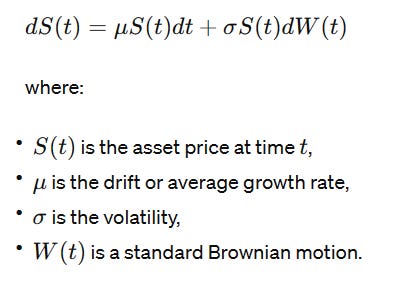
Geometric Brownian motion is a specific type of stochastic process that is commonly used in finance to model the continuous-time evolution of asset prices, such as stock prices. It is an extension of Brownian motion and has the following key features:
Exponential Growth: The process exhibits exponential growth or decay over time.
Drift and Volatility: It incorporates a drift term, representing the average rate of return or growth, and a volatility term, representing the random fluctuations around the average.
Log-Normal Distribution: The distribution of the process at any given time follows a log-normal distribution.
The equation describing Geometric Brownian Motion is often written in the form:
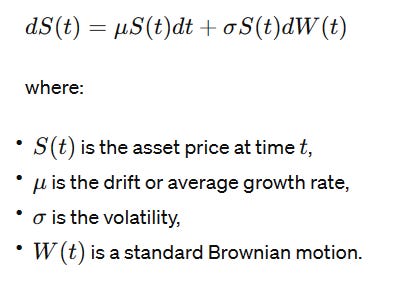
Geometric Brownian motion is a fundamental component of the Black-Scholes-Merton model, which is widely used for option pricing in financial markets. It provides a mathematical framework for capturing both deterministic trends and random fluctuations in asset prices over time.
………………
SOURCES :
chatGPT
Link to the Chat : https://chat.openai.com/share/a4a26a81-da0b-4bfd-bc57-9809709a0f00
Thanks for reading RhPt 2 (Portfolio Website)! Subscribe for free to receive new posts and support my work.